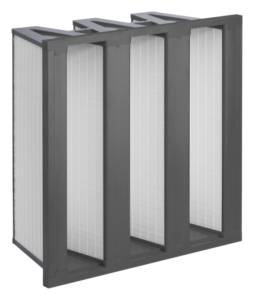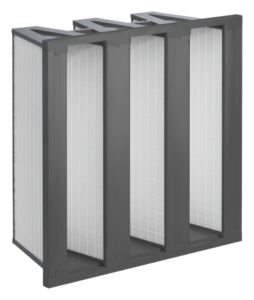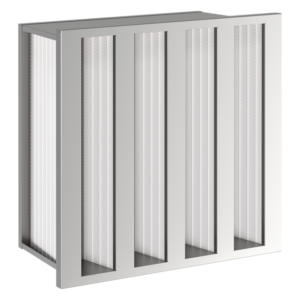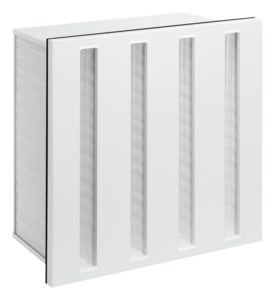




Description
Prefilters or final filters for the separation of fine dust and particulate filters for the highest requirements in ventilation and air-conditioning systems
- Filter groups ISO ePM10, ISO ePM1 (fine dust filter) and EPA, HEPA (particulate filter)
- Performance data tested according to ISO 16890 or to EN 1822-1 and ISO 29463-2 to ISO 29463-5
- Eurovent Certification for fine dust filters
- Meets the hygiene requirements of VDI 6022
- High energy efficiency class according to Eurovent
- Optimized energy efficiency of the PLA-ECO construction in ISO ePM1
- Filter media for special requirements made of glass fiber papers, with spacers made of hot-melt adhesive or textile threads
- Low initial differential pressure due to ideal pleat position and largest possible filter area
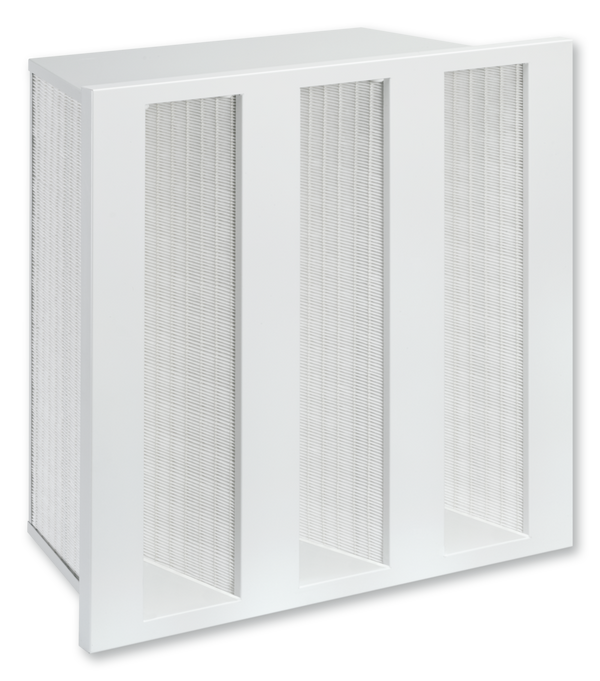
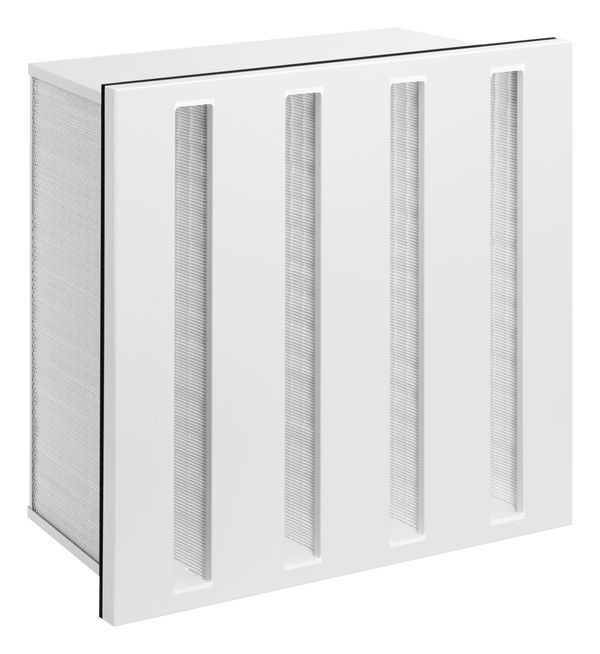
- Compact V-design with low installation depths
- Fitting depending on filter class, into standard cell frames for filter walls (type SIF), into mounting frames (type MF), or into universal casings (type UCA) for duct installation
Optional equipment
- ATEX construction for protection zones 1 and 2 as well as 21 and 22
General information
Application
- Mini Pleat filter insert for the separation of fine dust and suspended particles such as aerosols, toxic dusts, viruses and bacteria from the supply and extract air in ventilation and air conditioning systems with large volume flow rates and long filter service lives
- Fine dust filter: Prefilter or final filter for the separation of fine dust in ventilation systems.
- Particulate filter: Main or final filter used for the most critical requirements of air cleanliness and sterility in areas such as industry, research, medicine, pharmaceuticals, and nuclear engineering
Special characteristics
- Optimized energy efficiency of the PLA-ECO construction in ISO ePM1
- Leakage test is standard for all particulate filters of classes H13, H14
Classification
- Eurovent certification for fine dust filters
- Meets the hygiene requirements
- Certificate of conformity for use in areas with a potentially explosive atmosphere
Nominal sizes
- B ? H ? T [mm]
Filter groups
- ISO ePM10 acc. to ISO 16890
- ISO ePM1 acc. to ISO 16890
- EPA according to EN 1822
- HEPA according to EN 1822
Filter classes
- ePM10 55 %
- ePM1 55 %
- ePM1 60 %
- ePM1 85 %
- E10
- E11
- H13
- H14
Options
- Number of filter packs
- FNU: Flat seal on the upstream side
- FND: Flat seal on the downstream side
- OT: Oil mist test (only for filter classes H13, H14)
- OTC: Oil mist test with certificate (only for filter classes H13, H14)
Construction
- PLA: Frame made of plastic
- PLA-ECO: plastic frame, optimized energy efficiency
- GAL: Frame made of galvanized steel
- SPC: frame steel galvanized, powder-coated, RAL 9010 (pure white)
- EX: Protection zones 1 and 2 as well as 21 and 22 (only in combination with frame version GAL)
Useful additions
- Filter wall (SIF) for fine dust filters
- Mounting frame (MF) for EPA and HEPA filters
- Universal casing (UCA) for fine dust filters
Construction features
- Compact V-design
- Fine dust filter (filter groups according to ISO 16890) as standard without seal, optionally with flat seal
- Filter classes E10, E11, H13 and H14 as standard with flat seal
- Filter classes E11, H13 and H14 with protection grid on the downstream side
Material and surfaces
- Filter media made of high-quality, wet-strength glass fiber papers, pleated
- Spacers provide a uniform spacing of the pleats
- Joint sealing compound made of permanently elastic two-component polyurethane adhesive
- Frame options: made of plastic, galvanized steel or of galvanized sheet steel, powder-coated RAL 9010, pure white
Standards and guidelines
- Test according to ISO 16890; international standard for general ventilation and air conditioning; classification of arrestance efficiency based on the measured fractional arrestance efficiency, which is processed into a reporting system for the fine dust arrestance efficiency (ePM)
- For fine dust filters, the fractional arrestance efficiency of a certain size range is determined by aerosols (DEHS and KCl)
- The filters are classified into filter groups ISO ePM10 and ISO ePM1 depending on the tested values
- Testing of particulate filters according to EN 1822-1 and ISO 29463-2 to ISO 29463-5 (EPA, HEPA and ULPA particulate filters): standards for the testing of filtration performance in the manufacturer’s factory, particle counting method using a liquid test aerosol
- Uniform classification of particulate filters according to efficiency, using a test aerosol whose average particle size lies within the minimum efficiency (MPPS)
- Particulate filters are classified according to the values determined for the local filtration efficiency and the overall filtration efficiency as EPA (filter classes E10, E11, E12), HEPA (filter classes H13, H14) or ULPA (filter classes U15, U16, U17)
- Hygiene conformity: VDI 6022, VDI 3803, DIN 1946 Part 4, ?NORM H 6020, SWKI VA 104-01 and SWKI 99-3 and EN 16798
- Certificate of conformity for correct use in areas with a potentially explosive atmosphere in accordance with guideline 2014/34/EU and compliance with basic health and safety requirements in accordance with EN 80079-36:2016 and EN 80079-37:2016
| Fractional efficiency ePM10 [%] to ISO 16890 | 55 | ? | ? |
| Fractional efficiency ePM1 [%] to ISO 16890 | ? | 60 | 85 |
| Initial differential pressure [Pa] at nominal volume flow rate | 80 | 105 | 130 |
| Final differential pressure [Pa] | 450 | 450 | 450 |
| Maximum operating temperature [?C] | 80 | 80 | 80 |
| Maximum relative humidity [%] | 100 | 100 | 100 |
| Filter class according to EN?1822 | E10 | E11 | H13 | H14 |
| Efficiency [%] according to EN?1822 | > 85 | > 95 | > 99.95 | > 99.995 |
| Initial differential pressure [Pa] at nominal volume flow rate | 160 | 160 | 265 | 300 |
| Final differential pressure [Pa] | 450 | 450 | 600 | 600 |
| Maximum operating temperature [?C] | 80 | 80 | 80 | 80 |
| Maximum relative humidity [%] | 100 | 100 | 100 | 100 |
Order Code:
| MFI | ? | H13 | ? | ? | GAL | / | 592 ? 592 ? 292 | ? | 8 | / | PD | / | FNU | / | OT | |
| | | | | | | | | | | | | | | | | | | ||||||||
| 1 | 2 | 3 | 4 | 5 | 6 | 7 | 8 | 9 |
1 Type: MFI Mini Pleat filter insert
2 Classification
ePM1 Fractional efficiency ePM1 acc. to ISO 16890
ePM10 Fractional efficiency ePM10 acc. to ISO 16890
E10 Filter class E10 according to EN 1822
E11 Filter class E11 according to EN 1822
H13 Filter class H13 according to EN 1822
H14 Filter class H14 according to EN 1822
3 Separation efficiency
Specify the separation efficiency [%] according to ISO 16890?(not for E10, E11, H13, H14)
4 Construction
PLA Frame made of plastic
PLA-ECO Plastic frame, optimized energy efficiency
GAL Frame made of galvanized sheet steel
SPC Frame made of galvanized sheet steel, powder-coated RAL 9010 (pure white)
EX Frame made of galvanized sheet steel, for zones 1 and 2 as well as 21 and 22 in areas with potentially explosive atmospheres (EX)
5 Nominal size [mm]
Specify width ? height ? depth
6 Number of filter packs
6, 8
7 Protection grid
No entry: without protection grid
PD Protection grid on the downstream side (E11, H13, H14 only)
8 Seal
No entry: without seal
FNU Flat seal on the upstream side
FND Flat seal on the downstream side
9 Testing
No entry: no leakage test
OT Oil mist test (only H13, H14)
OTC Oil mist test with certificate (only H13, H14)
Order example: MFI-H13-GAL/592?592?292?8/PD/FNU/OT
| Type | MFI |
| Classification | Filter class H13 according to EN 1822 |
| Separation efficiency | – |
| Variant | Frame made of galvanized sheet steel |
| Nominal size [mm] | Width 592, height 592, depth 292 |
| Number of filter packs | 8 |
| Protection grid | Protection grid on the upstream side |
| Seal | Flat seal on the downstream side |
| Testing | Oil mist test |
Literature