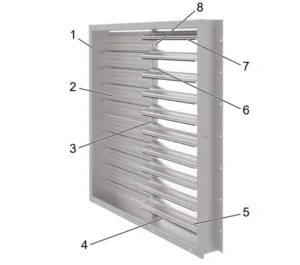


General Information
Application
- Non-return dampers for installation in ducts
- Prevention of unwanted airflows against the intended airflow direction when the system is not in operation
- Blades close automatically when the system is shut down
- Maximum differential pressure 0.4 in w.g.
Special features
- Any intermediate sizes within the standard size range are available
- Operating temperature -4 to 176 °F
- Maximum differential pressure: 0.4 in w.g.
- Non-return dampers are opened and closed by the airflow; no actuator is required
- Non-return damper with formed aluminium blades for normal requirements; blades are fitted with seals for attenuating the blade noise
Nominal sizes
- B: 8, 16, 24, 32, 39, 47, 55, 63 in (intermediate sizes: 8 – 63 in in increments of 0.04 in)
- H: 8, 12, 16, 20, 24, 28, 32, 40, 48, 56, 64 in (intermediate sizes: 9 – 64 in, in increments of 0.04 in); the design of the lowest blade and travel stop may differ depending on the damper height
- Any combination of B × H
Variants
- KUL: Casing without flange holes
- KUL-G: Casing with flange holes
Parts and characteristics
- Casing
- Blades with low-friction bearings
- Blade restrictors
- Blade tip seals
- Bottom travel stop (angle section)
- Visible mullion from B = 39 in
Accessories
- Installation subframe for the fast and simple installation of mechanical self-powered dampers (only KUL-G)
Construction features
- Casing, material thickness 0.05 in
- Blades, material thickness 0.04 in
- Casing with flanges on both sides
- Additional side bar with fixing holes to accommodate the blade shafts and integral blade restrictors
- Blade restrictors prevent the blades from opening beyond a certain angle
Materials and surfaces
- Casing, mullion and travel stop (angle section) made of galvanised sheet steel
- Blades made of formed aluminium
- Blade shafts made of brass
- Side bar made of PVC plastic
- Blade tip seals made of polyester foam
- Blade restrictors made of PC plastic
- P1: Powder-coated, RAL CLASSIC colour
Maintenance
- Maintenance-free as construction and materials are not subject to wear
- Contamination should be removed as it may lead to corrosion and to increased closed blade air leakage