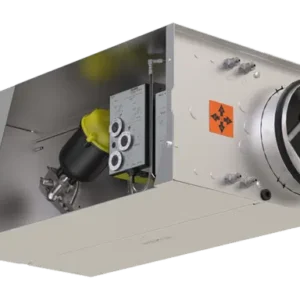
Function
Functional description
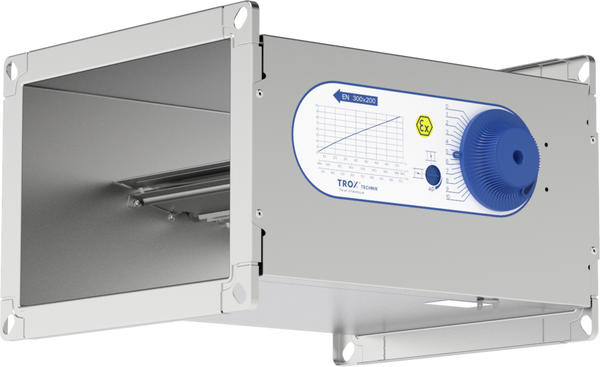
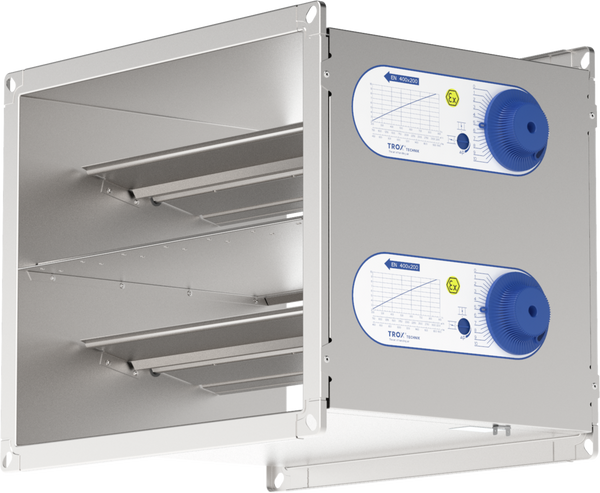
The air terminal unit is a mechanical self-powered unit and works without external power supply. A damper blade with low-friction bearings is adjusted by aerodynamic forces so that the set volume flow rate is kept constant within the differential pressure range. The aerodynamic forces of the airflow create a closing torque on the damper blade. An inflating bellows amplifies this force and at the same time acts as a damping element. The closing torque is countered by a leaf spring that unrolls over a cam plate. The cam plate is adapted in such a way that the damper blade moves when the differential pressure changes. As a result, the volume flow rate remains constant within narrow tolerances.
Efficient commissioning
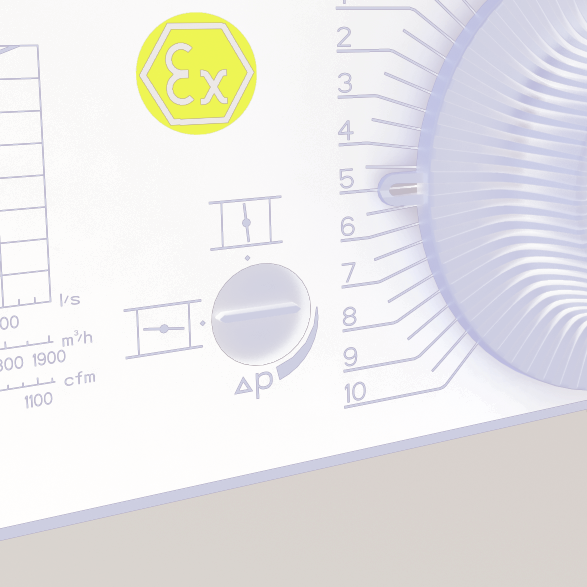
Using the rotary knob, the desired volume flow setpoint can be set quickly on the external scale, no prior measurement required. The advantage over conventional flow adjustment dampers is that no repeated measurements or adjustments during commissioning are required. Should the system pressure change, e.g. by opening or closing of duct sections, the flow rates in the entire system will also change if flow adjustment dampers are used; however, this is not the case with mechanical self-powered air terminal units. The air terminal unit reacts immediately and keeps the set air volume constant.
Schematic Illustration of the EN-Ex
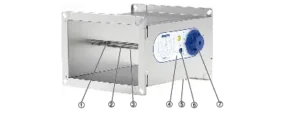
① Damper blade
② Bellows
③ Bellows inlet
④ Scale sticker
⑤ Connection for equipotential bonding
⑥ Visual display of the damper blade position
⑦ Rotary knob
Specification Text
Air terminal units in rectangular design for constant air volume systems, mechanically self-powered, without external power supply, for supply or extract air, in 19 nominal sizes. Air terminal unit ready for commissioning, consisting of the casing with smooth-running control damper, control bellows and external cam disc with leaf spring as well as components for equipotential bonding and explosion protection. The air terminal units are factory adjusted and preset to a reference air volume. Sound power level measured according to DIN EN ISO 5135. Meets the hygiene requirements according to VDI 6022. Meets the requirements of ATEX Directive 2014/34 EU.
Special features
- ATEX mark and certification
- ATEX equipment-group II, approved for zones 1, 2, 21 and 22
- Setting of the volume flow setpoint from the outside by rotary knob
- High control accuracy of the set volume flow rate
- Correct operation even under unfavourable upstream conditions
- Visual display of the damper blade position for operating point optimisation
Materials and surfaces
Galvanised sheet steel construction
- Casing and damper blade made of galvanised sheet steel
- Leaf spring made of stainless steel
- Polyurethane bellows
- Plain bearings with PTFE coating
- Cam plate and adjusting unit made of galvanised sheet steel
Powder-coated construction (P1)
- Casing and damper blade made of galvanised sheet steel,
- powder-coated
- Leaf spring made of stainless steel
- Polyurethane bellows
- Plain bearings with PTFE coating
- Cam plate and adjusting unit made of galvanised sheet steel
Variant with acoustic cladding (-D)
- Acoustic cladding made of galvanised sheet steel
- Rubber seal for the insulation of structure-borne noise
- Lining made of mineral wool
Mineral wool
- Acc. to EN 13501, fire rating class A1, non-combustible
- RAL quality mark RAL-GZ 388
- Non-hazardous thanks to high biosolubility according to the German Ordinance on Hazardous Substances and Note Q of the European Regulation (EC) No. 1272/2008
Construction
- Galvanised sheet steel
- P1: Powder-coated, silver grey (RAL 7001)
Technical data
- Nominal sizes: 8 × 4 to 24 × 24 in
- Volume flow rate range: 83 – 7416 cfm
- Volume flow rate control range: approx. 25 – 100 % of the nominal volume flow rate
- Minimum differential pressure: 0.20 in wg
- Maximum permissible differential pressure: 4.02 in wg
- Casing air leakage acc. to EN 1751, class C