

General Information
Application
- Stainless steel and powder-coated construction
Special characteristics
- Aerofoil blades
- Low-maintenance, robust construction
- No parts with silicone
- Available in standard sizes and many intermediate sizes
- Closed cell side seals meet increased hygiene requirements
Classification
- Closed blade air leakage to EN 1751
Test pressure up to 8.04 in w.g.
- Up to B = 24 in, class 3
- B = 24 – 79 in, class 4
Test pressure up to 4.02 in w.g.
- Up to B = 24 in, class 3
- B = 24 – 79 in, class 4
Nominal sizes
- B: 8 – 79 in, in increments of 0.04 in
- Width subdivided (BM): 79 – 163 in, in increments of 0.04 in
- H: 7, 14, 20, 27, 33, 40, 46, 53, 59, 66, 72, 79 in (intermediate sizes 7 – 79 in increments of 0.04 in, except for standard size H – 0.04 in, H + 0.04 in, H + 0.08 in)
- Height subdivided (HM): 79 – 160 in, in increments of 0.04 in
- Any combination of B × H
Variants
- JZ-LL: Multileaf damper with opposed blade action, made of galvanised sheet steel
- JZ-LL-A2: Multileaf damper with opposed blade action, made of stainless steel
Constructions
- Duct connection
- Corner holes on both sides
- G: Flange holes on both sides
Bearings
- Plastic bearings, operating temperature 32 – 212 °F
- M: Brass bearings, operating temperature 32 – 212 °F
- E: Stainless steel bearings, operating temperature 32 – 212 °F
Blades
- Only for steel multileaf dampers with brass or stainless steel bearings (JZ-…-M, JZ-…-E)
- V: Reinforced blades available as from width 32 in
Parts and characteristics
- Ready-to-install shut-off damper
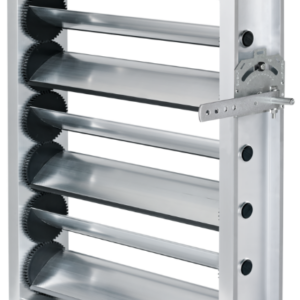
- Blades with external linkage
- Drive arm
Attachments
- Quadrant stays and limit switches: Quadrant stays to adjust the damper blades (infinite adjustment) and for capturing the end positions
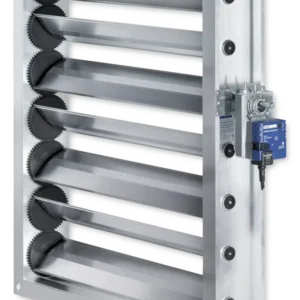
- Open/close actuators: Actuators for opening and closing multileaf dampers
- Modulating actuators: Actuators for infinite blade blade adjustment
- Pneumatic actuators: Pneumatic actuators for opening and closing multileaf dampers
- Explosion-proof actuators: Actuators for opening and closing multileaf dampers installed in potentially explosive atmospheres
Accessories
- Installation subframe: Installation subframe for the fast and simple installation of multileaf dampers
Construction features
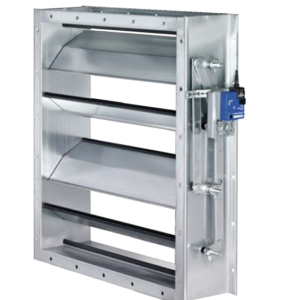
- Rectangular casing, welded (P1: casing with screws), material thickness galvanised steel 0.05 in, stainless steel A2 = 0.05 in
- Blades, material thickness 0.04 in
- Flanges on both sides, suitable for duct connection, either flange holes or corner holes
- External linkage, robust and durable, consisting of the coupling rod and horizontal arms
- Damper blade shafts, Ø0.5 in, with notch to indicate the damper blade position (not for attachment ZS99)
- With drive shaft as an attachment: For the position of the drive shaft see ‘Dimensions and weight’
- With actuator as an attachment: The actuator is always attached to the second blade from the top
- Travel stop (angle section) ensures tight closure of the top and bottom blades
- Blade tip seals and side seals
- The construction and selection of materials comply with the criteria stipulated in European directives, referred to as ATEX (for use in potentially explosive atmospheres) for variants with brass or stainless steel bearings (-M, -E)
Material and surfaces
- Casing and blades made of galvanised sheet steel or stainless steel
- Blade shafts, drive arm and external linkage made of galvanised steel or stainless steel
- Plastic, brass or stainless steel bearings
- Blade tip seals made of PP/PTV plastic
- Side seals made of closed cell PE foam
- P1: Powder-coated, RAL CLASSIC colour
- PS: Powder-coated, DB colour
Standards and guidelines
- Casing air leakage to EN 1751, class C
- Meets the general requirements of DIN 1946, Part 4, with regard to the acceptable closed multileaf damper air leakage
- Multileaf damper sizes from B = 24 in meet the increased requirements of DIN 1946, Part 4, with regard to the maximum closed multileaf damper air leakage
Maintenance
- Maintenance-free as construction and materials are not subject to wear
- Contamination should be removed as it may lead to corrosion and to increased closed multileaf damper air leakage