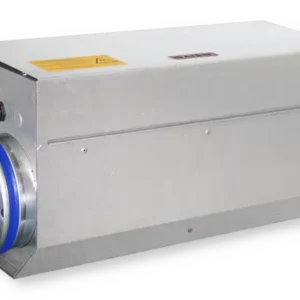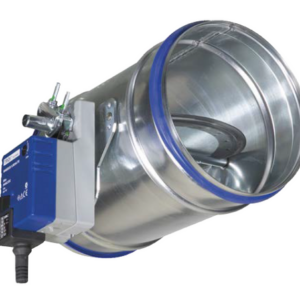
TROX AKK – Plastic circular shut-off dampers for contaminated air

Call for Price

For contaminated air

Plastic circular shut-off dampers for shutting off aggressive media volume flows in air conditioning systems

  • Maintenance-free damper blade mechanism
  • Closed blade air leakage to EN 1751, class 3
  • Casing air leakage to EN 1751, class C


Optional equipment and accessories

  • Electric actuator
  • Spring return actuator
  • Pneumatic actuator
  • Auxiliary switch with adjustable switching points for capturing the end positions


SKU: AKK Category: Tag:

General Information

Application

  • Plastic circular shut-off dampers Type AKK for shutting off or restricting the airflow in ventilation ducts of air conditioning systems
  • Suitable for contaminated air


Special features

  • Damper blade can be actuated manually, electrically or pneumatically
  • Low-leakage shut-off
  • Safety function provided by optional spring return actuator


Nominal sizes

  • 5, 6, 8, 10, 12, 16


Variants

  • AKK: Shut-off damper
  • AKK-FL: Shut-off damper with flanges on both ends


Parts and characteristics

  • Ready-to-install shut-off damper
  • Damper blade with blade mechanism


Attachments

  • Open/Close actuators: For the opening and closing of shut-off dampers in air conditioning systems
  • Auxiliary switch for capturing the end positions


Accessories

  • Matching flanges for both ends, including seals


Technical data
  • Nominal sizes: 5 – 16 in
  • Acceptable static differential pressure: 6.02 in w.g.


Standards and guidelines
  • Meets the hygiene requirements of VDI 6022
  • Closed blade air leakage to EN 1751, class 3
  • Meets the general requirements of DIN 1946, part 4, with regard to the acceptable closed blade air leakage
  • Casing air leakage to EN 1751, class C


Maintenance
  • Maintenance-free, as construction and materials are not subject to wear and tear

Function

Functional description
For airtight shut-off of volume flows in round plastic air ducts – typically for contaminated extract air in laboratories. The basic version is shut off by manually actuating the damper blade. Electrically or pneumatically operated actuators, which are available in different versions, can also be used to operate the damper blade. The versions differ with regard to the power supply and safety position (de-energised or de-pressurised state). Actuators with auxiliary switches for electrical monitoring of the damper blade position are also available.

The actuator of a damper blade must be controlled by a customer-side circuit and then moves the damper blade to the OPEN or CLOSED position.


AKK: Schematic Diagram (Version with Flange)

1 Damper blade

2 Plain bearings

3 Flange (optional)

4 Actuator (optional)

Specification Text

Circular shut-off dampers in PPs plastic for air conditioning systems, available in 6 nominal sizes. Suitable for shutting off or restricting extract air flows containing aggressive substances since all components coming into contact with the airflow are made of plastic (no interior metal parts).

Suitable for duct pressures up to 6.02 in w.g.

Ready-to-install unit consists of the casing with a damper blade.

Spigot, suitable for ducts according to DIN 8077.

Position of the damper blade indicated externally at the shaft extension.

Closed blade air leakage to EN 1751, class 3.

Casing air leakage to EN 1751, class C.


Special features

  • Damper blade can be actuated manually, electrically or pneumatically
  • Low-leakage shut-off
  • Safety function provided by optional spring return actuator


Materials and surfaces

  • Casing and damper blade made of flame-resistant
  • polypropylene (PPs)
  • Plain bearings made of polypropylene (PP)
  • Damper blade seals in chloroprene rubber (CR)


Technical data

  1. Nominal sizes: 5 – 16 in
  2. Acceptable static differential pressure: 6.02 in w.g.

Downloads

AKK_HC_2020_06_08_DE_enpdf.pdf

AKK Declaration of Conformity or Declaration of Incorporation

AKK Declaration of Hygiene Conformity

AKK Manufacturer’s Statement Concerning Statistical Leakage Tests